





A BOOST FOR YOUR IMMUNE DEFENSES
Fasting and physical activity
Our peer reviewed research has shown that muscle mass and strength remain stable during long-term fasting, challenging long held assumptions about muscle loss. We are now building on this work to understand how structured movement can amplify and complement the body’s natural fasting responses.
In Marbella, our team will be running the FASTEX study, a controlled trial comparing different activity programmes during fasting and supported by advanced body composition scans for precise tracking of body composition changes. Last week we also hosted our annual medical conference, where experts shared the latest findings on physical activity, longevity, and therapeutic fasting.
Can exercise complement fasting?
Fasting is typically thought of as a time of slowing down, a period devoted to rest, introspection, and reducing external demands. While this restorative aspect remains valuable, new research shows that fasting does not always require stillness. In fact, the body stays highly adaptive during a fast, and certain types of movement can work with these changes rather than against them.
Recent clinical evidence indicates that fasting and physical activity are not opposing forces but can be complementary when planned well. Understanding this relationship matters, because fasting is now recognised not only as a nutritional intervention but as a whole-body signal that affects muscle, metabolism, daily rhythm and long-term health.

Is it possible to combine fasting and structured movement safely to achieve greater health benefits than either alone? Here, at Buchinger Wilhelmi, this question sits at the centre of ongoing research. We want to understand how physical activity interacts with fasting, and what kinds of movement support resilience rather than strain.
The goal is not simply to reassure people that light activity is safe during fasting, but to understand how fasting and movement work together to influence strength, metabolic health and long-term wellbeing.

To do this, we are building on previous muscle research, using new advanced diagnostic tools in our clinics, running controlled trials and hosting an international congress focused on exercise and longevity. Ultimately, these efforts aim to create clear, evidence-based guidance on how movement can align with fasting to support health in a more personalised and effective way.
A recap of what we know so far: muscle health and body composition during long-term fasting
Our recent research, including the GENESIS muscle study, has shifted how we understand the body’s response to long-term fasting. Early assumptions suggested fasting would inevitably weaken muscle, however, the use of advanced medical testing revealed a more nuanced and encouraging picture. These assessments showed that most of the early drop in lean tissue is due to water and stored glucose loss rather than actual muscle loss. Muscle structure remained stable, energy producing mitochondria continued to function well or even improved, and strength was maintained. We also saw that fat inside the muscle was reorganised towards areas where it can be used more efficiently, and that the hormonal changes after refeeding created ideal conditions for recovery and rebuilding.
Taken together, these findings indicate that controlled, long term fasting does not weaken muscle as many people assume. Instead, it reshapes how the body uses energy and improves metabolic flexibility, creating a state in which muscles may become even more responsive to movement.
This naturally led to the next question: if fasting already supports muscle efficiency, could adding structured physical activity strengthen these benefits even further?
Introducing the FASTEX programme
To build on these insights, the team in Marbella has launched the FASTEX study, a randomised controlled trial examining how structured resistance training works alongside the Buchinger Wilhelmi fasting method.
The study compares three groups:
- Control cohort
- Fasting group completing a familiarisation phase
- FASTEX group, who follow a supervised resistance training plan created with our exercise specialists
Participants are assessed on several key measures such as handgrip strength, muscle quality, sit to stand performance, lactate levels and overall quality of life. Sleep is also monitored using wearable devices, as good sleep plays an important role in metabolic balance, recovery and the body’s ability to adapt during fasting. By tracking movement and sleep continuously throughout the programme, we can see how people respond in real time rather than only comparing results at the end.
The aim is to understand how fasting and exercise work together, not just whether they can safely coexist. By studying their combined effects, we hope to see whether movement during fasting can further improve physical fitness, metabolic health and sleep quality. If these patterns become clear, they could guide future programmes that use personalised activity plans to strengthen the cardiometabolic and healthy ageing benefits of fasting.
Precision body composition analysis with DEXA
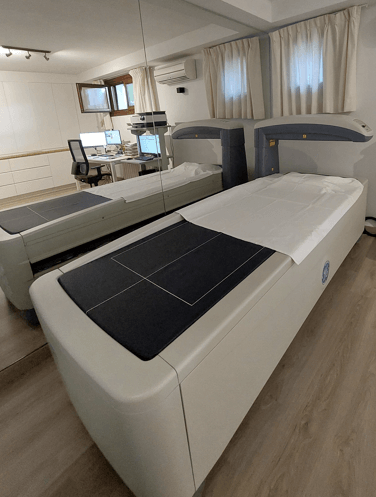
Alongside the FASTEX study, our clinic in Marbella now offers DEXA scanning (Dual Energy X ray Absorptiometry), the gold standard for assessing body composition. We are pleased to integrate this tool into our clinical practice because, unlike simple weight measurements, DEXA provides clear, detailed information on fat mass, muscle mass and bone density. This helps clinicians understand real metabolic change rather than shifts that may simply reflect water loss or short-term fluctuations. Since fasting affects tissues in different ways, having this level of precision is essential for safe and personalised care.
By incorporating DEXA into routine evaluations, the medical team can tailor fasting and activity programmes more accurately, supporting safety and long-term results. It also allows us to track subtle changes in muscle quality that may not show up in basic performance tests. This reflects our wider commitment to blending tradition with modern science, using advanced tools to refine well established therapeutic approaches.
Why physical activity matters during fasting
Movement influences almost every adaptive process that takes place during fasting. Light to moderate activity can help steady blood sugar, improve fat burning, protect muscle, support appetite regulation and lift mood. It also helps keep the body’s internal clock aligned, which is vital for metabolic balance. During fasting, this daily rhythm becomes even more important because many organs rely on these regular patterns to function well.
Physical activity also affects sleep, an essential but often overlooked part of the fasting process. Better sleep supports emotional wellbeing, strengthens the immune system and enhances the metabolic benefits of fasting. The FASTEX study is one of the first controlled trials to track sleep continuously during fasting, and its findings will help clarify how movement influences recovery, energy and overall wellbeing.
Advancing the science of movement, fasting, and ageing
As new findings emerge from clinical studies and modern diagnostic tools, it is increasingly important to share these insights with the wider scientific and medical community.

By loading the video, you agree to YouTube's privacy policy.
Learn more
On 22nd November 2025, Buchinger Wilhelmi Marbella hosted a medical congress focused on physical activity and healthy ageing. Experts in nutrition, exercise science and clinical medicine met to discuss how movement supports long term health. Topics included:
- Fasting and ageing
- The GENESIS muscle study
- Exercise as therapy
- Metabolism
- Daily biological rhythms
- The role of movement in mental health
- Menopause
Speakers included Dr Robin Mesnage, Felipe Isidro Donate, Carmen Rodríguez García, Xevi Verdaguer, María Rodríguez Ayllón and Manuel Martín Olvera, together with members of the Buchinger Wilhelmi medical and scientific team. This event represents a growing scientific consensus that healthy ageing requires both metabolic flexibility and physical capability, and that fasting and activity can work together to support both.
Towards personalised movement during fasting
Current evidence points to a simple but important shift in thinking. Fasting does not remove the need for physical activity, it changes the conditions in which movement works. During a fast, muscles become more sensitive to physical and metabolic signals, meaning that even light resistance or aerobic exercise can have measurable benefits. As research grows, it is becoming increasingly clear that fasting and exercise should be considered together rather than in isolation.
This is where precision matters. Using tools such as DEXA scans, continuous activity and sleep tracking, and structured training plans helps us see how different bodies respond to fasting more clearly. It also helps distinguish healthy adaptations from unhealthy ones. For instance, the body composition changes seen with supervised therapeutic fasting are very different from those caused by long-term appetite suppressants like GLP 1 drugs, which can reduce muscle and bone density without offering the same protective metabolic changes. Tools like DEXA help clinicians tell these patterns apart and guide people towards approaches that support healthy ageing rather than compromise it.
With this approach, personalised fasting and movement plans become possible. Biomarkers, baseline fitness, sleep quality, metabolic status and individual goals can all be used to tailor activity in ways that improve both safety and effectiveness. Instead of asking whether exercise is compatible with fasting, the evidence now points us toward a better question: how can the two be combined to support metabolic health, physical capability and long-term resilience?
Science is beginning to answer that question, and the early signals are encouraging.
That might also interest you:

