






THE INVERTED FOOD PYRAMID
Dietary recommendations at a glance
Let us imagine a brief thought experiment. The US Secretary of Health might ask an artificial intelligence to create as much confusion as possible within the global nutrition debate. The resulting recommendations could look something like this: turn the food pyramid upside down so that its stability disappears. Present meat, dairy products and other animal foods as the central pillar of human nutrition. Legumes, although inexpensive, long lasting and rich in protein, may quietly fade into the background. After all, they do not necessarily align with the current interests of the American meat industry.
Carbohydrates could then be portrayed broadly as a problem, preferably without the inconvenient distinction between highly sweetened breakfast cereals and a traditional organic whole grain sourdough bread made from regional grains. The existence of cold pressed seed oils and their essential polyunsaturated fatty acids might also be discreetly overlooked. As pointed as this thought experiment may initially sound, surprising parallels can be found in the US dietary recommendations that were published only a few weeks ago. These new guidelines appear remarkably relaxed in their treatment of a large body of current scientific evidence as well as established national and international recommendations. In a field that is already known for its complexity, this development has added a further layer of uncertainty. This is particularly relevant because images often shape perception more strongly than words. What appears as the foundation seems essential and self-evident. What moves upward appears secondary. A redesigned pyramid is therefore not simply a graphic variation. It reflects a shift in how nutrition is understood.
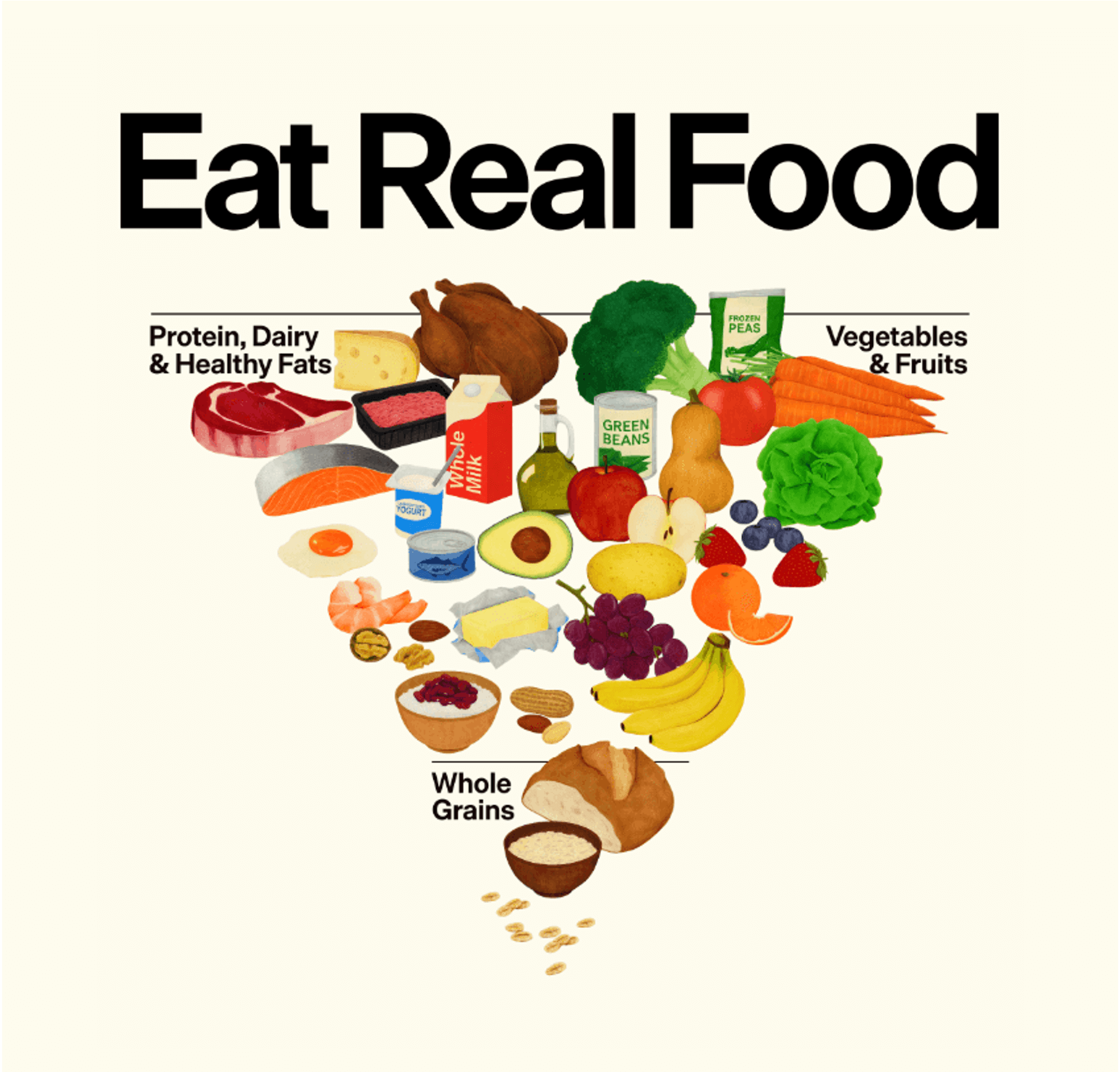
Image Source: Official Website of the US Government
Françoise Wilhelmi de Toledo emphasizes that dietary guidance works not only through scientific data but through visual frameworks. When images redefine priorities, they influence the eating patterns of entire populations over time, often subtly but with lasting impact. At a time when nutrition is intensely debated both socially and politically, such symbolism carries particular weight.

Health is more than protein, fat and carbohydrates
For decades the so called food pyramid has served as a guide. Its visual principle is simple and intuitive. The broad base contains those foods that should be consumed regularly and in greater quantities. Toward the top appear foods that are best enjoyed more sparingly. Internationally there is now a broad scientific consensus that a predominantly plant based diet is associated with significant health benefits. This is particularly relevant in societies where daily life is largely sedentary and energy expenditure remains relatively limited.
In contrast stands a high consumption of meat products. These foods do provide valuable protein but are often rich in saturated fats and cholesterol and may also contain residues of medications or pesticides. Dietary fibre is almost entirely absent. Numerous epidemiological studies associate such dietary patterns with a higher risk of cardiovascular diseases, chronic inflammatory processes and possibly certain types of cancer. In the long term this pattern does not appear to support optimal health for the human organism.
Nutrition is also a systemic question
Beyond health considerations, ecological and climatic aspects also come into focus. It is estimated that roughly twenty percent of global greenhouse gas emissions are linked to conventional animal farming and animal production. This impact is further intensified by energy intensive cooling chains, long transport routes and the considerable amount of plastic packaging involved. The resulting logistical system often resembles a global industrial network more than traditional agriculture.
Another factor is the fundamental inefficiency of the system. Converting plant protein into animal protein requires large quantities of feed. Producing one kilogram of meat protein requires roughly ten times the amount of plant based food. These are resources that many exporting countries urgently need for their own populations. Ethical considerations also arise. Industrial livestock farming and large scale slaughter operations have for years been the subject of ongoing social and moral debate.
Eat Real Food
Against this background it is perhaps not entirely surprising that representatives of the meat and dairy industries were involved in the development of the new US dietary guidelines. The consequences of such recommendations are far from insignificant. They affect around three hundred million people and also shape the food provided in schools, hospitals and other publicly funded institutions.
One recommendation nevertheless deserves particular attention: “Eat real food”. The call to favour minimally processed foods and to reduce highly processed industrial products reflects a principle that is widely supported in nutritional science. In this respect political messaging and scientific understanding meet in a constructive way. The emphasis on natural and minimally processed foods can therefore be regarded as a meaningful contribution to the current nutrition debate.
Nutrition at Buchinger Wilhelmi
At Buchinger Wilhelmi, nutrition has always been understood as part of a broader therapeutic context. In medically supervised fasting therapy, it becomes clear how sensitively the organism responds to the quality and composition of food. Regeneration, metabolic balance and mental clarity are sustainably supported by a predominantly plant-based, minimally processed diet. Nutrition is not a short-term trend but a long-term determinant of health.
The debate surrounding the inverted food pyramid highlights one central point. Orientation does not arise from striking images alone but from differentiated, evidence based and responsible communication. The question is not whether to defend established models or reject new ones reflexively. It is about carefully evaluating scientific findings and placing them within a broader context.
Or, as Françoise Wilhelmi de Toledo puts it, the pyramid should not stand at the centre, but the human being in all biological, social and ecological dimensions.


Das könnte Sie auch interessieren: