








EXPLORING FIBRE DURING FASTING
Should we consume more dietary fibre during prolonged fasting?
Fasting profoundly changes how the body uses energy. As the body switches to stored fat and ketone bodies as energy sources, gut microbes lose much of their usual nourishment, particularly fermentable fibre.
This raises an important question: could we preserve the metabolic effects of fasting while continuing to provide selected fibres to the gut microbiome? Could this be a more natural way of fasting? Our forthcoming CoFFIe study explores this possibility.
Fasting remodels the gut microbiota
Our scientific team showed that fasting decreases bacteria that process dietary carbohydrates, particularly fibre, and increases microbes that feed on host-derived secretions such as mucus (LINK). These microbial changes help reorient energy metabolism and could be linked to improvements in blood pressure and body weight.
And it is not only about bacteria. In a clinical study published in the journal npj Biofilms and Microbiomes (LINK), we examined the intestinal virome of 89 people during 10 days of fasting. The virome consists mainly of bacteriophages: viruses that infect bacteria and can influence microbial competition and ecosystem organisation.
Fasting temporarily reduced viral diversity and reorganised the connections between viruses and bacteria. Importantly, many of the bacterial hosts associated with these viruses belonged to genera such as Faecalibacterium, Roseburia, Eubacterium and Clostridium. These bacteria play an important role in fermenting dietary fibre to produce compounds with known health benefits, such as short-chain fatty acids, including butyrate.
This connection is biologically plausible. Fibre fermentation is dramatically reduced during fasting because almost no dietary fibre reaches the colon.
The viral changes may therefore reflect, and perhaps contribute to, the reorganisation of fibre-fermenting bacterial communities. This was another reason we decided to examine dietary fibre in more detail.
Why fibre is so important
Fibre does more than support intestinal transit. Much of it reaches the colon, where it is fermented by microorganisms. This produces metabolites such as acetate, propionate and butyrate, which contribute to the nutrition of colon cells and the maintenance of intestinal barrier function.
Several landmark studies illustrate their importance.
- A major analysis (LINK) published in The Lancet, combining 185 prospective studies and 58 clinical trials, found that higher fibre consumption was associated with a 15–30% lower risk of several major outcomes, including cardiovascular mortality, coronary heart disease, stroke, type 2 diabetes and colorectal cancer. Benefits were apparent at intakes of approximately 25–29 grams per day and could increase further at higher intakes.
- In a clinical study (LINK) published in Science, a diet rich in diverse fibres selectively promoted a group of short-chain-fatty-acid-producing bacteria in people with type 2 diabetes. Participants in whom these bacteria increased most strongly also showed greater improvements in health outcomes.
- A meta-analysis (LINK) published in the American Journal of Clinical Nutrition combined 64 trials involving 2,099 participants. Fibre interventions increased Bifidobacterium, Lactobacillus and faecal butyrate. This is an important nuance: different fibres nourish different microorganisms, and their effects cannot be reduced to a single microbiome score.
Could fibre during fasting be more natural than we assume?
Periods of food scarcity in nature did not always mean a complete absence of food. Humans and other animals often turned to “fallback foods”: less preferred but more reliable resources, frequently including tough, fibre-rich plants.
This is particularly well documented among African apes (LINK). Western lowland gorillas are strongly attracted to ripe fruit, which can represent up to 70% of their feeding time when abundant. When fruit becomes scarce, they greatly increase their intake of leaves, herbs, bark and more fibrous fruits. Leaves can then account for up to 70% of feeding time in males and 50% in females. Chimpanzees also use fibrous pith and leaves when preferred fruits are less available.
Human foragers have likewise relied on tubers, berries, seeds and other wild plant foods during periods when preferred foods were unavailable. Their diets could remain high in fibre despite considerable seasonal variation.
This led us to consider a new hypothesis. Perhaps the complete absence of fibre during fasting is not the only biologically relevant model. A low-energy fasting programme containing a reasonable amount of selected fibre might maintain the metabolic switch while providing a limited substrate to the gut ecosystem.
The CoFFIe study: exploring fibre during fasting
The CoFFIe study—Combining Fasting and Fibre Interventions to Optimise Their Gut Microbiome-mediated Health Benefits—will test this hypothesis directly.
Seventy-five participants will undergo a Buchinger fasting programme lasting 10 ± 4 days. Fifty will receive maize-derived resistant starch type IV, while 25 will receive a maize-starch control. Resistant starch largely escapes digestion in the small intestine and reaches the colon, where it can be used by selected microorganisms.
We will examine whether fibre supplementation supports butyrate-producing bacteria and influences microbial function, butyrate production, glucose control, insulin sensitivity and ketosis. Metagenomic and metabolomic analyses will allow us to study not only which microorganisms are present, but also what they are doing.
A particular focus is placed on effects beyond the gut. To gain a deeper understanding of the systemic impact of fasting, we analyse extracellular vesicles in the blood. These microscopic particles, released by cells, act as biological messengers, carrying important molecular signals and proteins between organs. As innovative biomarkers in modern medicine, they provide valuable insights into how fasting regulates cellular communication throughout the body.
For this highly specialised research, we are delighted to welcome a visiting doctoral researcher from the University of Milan, who will conduct the analyses.
We are proud to collaborate with two leading research institutions for this study: the Leiden University Medical Center (LUMC), the Netherlands Organisation for Applied Scientific Research (TNO) and the University of Milan.
Practical takeaways: fibre is not limited to fibrous vegetables
Eating more fibre does not mean relying only on vegetables. Fruit can provide substantial amounts of fibre, particularly when eaten whole rather than as juice. Legumes, wholemeal bread and pasta, oats, barley, whole-grain cereals, nuts and seeds are also important sources.
Here are some simple swaps to increase your fibre consumption:
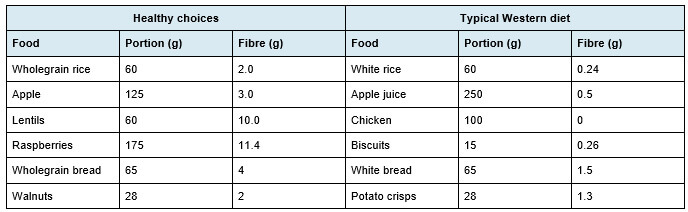
Our nutritional guidance therefore emphasises whole grains and legumes as fibre-rich carbohydrate sources that can support glycaemic control. A varied diet is preferable to relying on a single “superfood” or isolated supplement, because different plants provide different fibre structures to different microbial communities.
After fasting, these foods should be reintroduced progressively according to individual tolerance. The objective is not simply to consume the largest possible quantity of fibre. It is to restore a diverse and sustainable supply of substrates for a resilient gut ecosystem.
This might also interest you:

