






BE PART OF THE STUDY
Can fibre support the gut microbiome during fasting?
The CoFFIe study investigates whether selected dietary fibres can support beneficial changes in the gut microbiome during therapeutic fasting.
1. Why are we doing this study?
1.1. Fasting transforms the gut microbiome
During fasting, the body changes its main source of energy. It gradually moves away from dietary carbohydrates and begins using stored fat and ketone bodies.
The gut microbiome also undergoes major changes. Most gut microorganisms no longer receive the dietary fibres they normally use as food.
Our previous research showed that fasting reduces bacteria involved in processing dietary carbohydrates and increases microorganisms that can use compounds produced by the body, including intestinal mucus.
We have also observed changes in the intestinal virome – the community of viruses, mainly bacteriophages, that interact with gut bacteria. Many of the bacteria affected by these viruses are involved in fibre fermentation.
These findings led us to an important scientific question:
Could we maintain the metabolic effects of fasting while continuing to provide selected fibres to the gut microbiome?
1.2. Fibre also transforms the gut microbiome
Dietary fibre is not simply a substance that supports intestinal transit.
Much of the fibre we eat reaches the colon, where it is fermented by microorganisms. This fermentation produces metabolites such as acetate, propionate and butyrate.
These compounds contribute to:
- the nutrition of colon cells
- intestinal barrier function
- regulation of the immune system
- glucose and lipid metabolism
- control of inflammatory processes
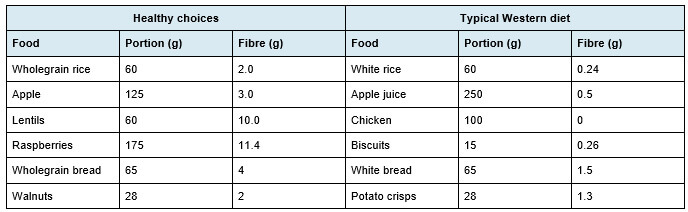
Eating more fibre does not mean relying only on visibly fibrous vegetables. Fruit can provide substantial amounts of fibre, particularly when eaten whole rather than as juice. Legumes, wholemeal bread and pasta, oats, barley, whole-grain cereals, nuts and seeds are also important sources.
Here are some examples of easy swaps to increase your fibre intake:
1.3. Can fasting and fibre join forces to transform the gut microbiome?
Periods of food scarcity in nature did not necessarily mean a complete absence of food.
Humans and other animals often relied on less preferred but more readily available foods, including roots, leaves, bark, seeds, berries and other fibre-rich plants.
African apes provide a well-documented example. When ripe fruit becomes scarce, gorillas and chimpanzees increase their consumption of leaves, fibrous plant tissues and other fallback foods.
This raises a new hypothesis. The complete disappearance of fibre may not be the only biologically relevant model of fasting.
A low-energy fasting programme containing a reasonable amount of selected fibre might preserve the metabolic switch associated with fasting while continuing to provide a limited substrate to the intestinal ecosystem.
2. The CoFFIe study: Optimising the health benefits of the gut microbiome through fasting and fibre interventions
CoFFIe stands for Combination of Fasting and Fibre Interventions.
The study examines whether consuming a specific fibre during therapeutic fasting can further support positive changes in the gut microbiome.
The study is conducted by the research department of Buchinger Wilhelmi Development & Holding GmbH, in collaboration with national and international research partners, including Leiden University Medical Center and the Netherlands Organisation for Applied Scientific Research.
2.1. How does the study work?
The study is a randomised, placebo-controlled intervention study involving approximately 75 participants undergoing the Buchinger fasting programme.
Participants are randomly assigned to one of two groups:
- Fibre group: Participants receive a daily supplement containing maize-derived resistant starch type IV. This form of resistant starch largely escapes digestion in the small intestine and therefore reaches the colon, where it can be used by selected gut microorganisms.
- Control group: Participants receive a corn-starch control product.
The study intervention does not replace the usual Buchinger fasting programme. It is added to the participant’s regular medically supervised stay.
Participation is voluntary and does not affect regular medical care.
2.2. What does participation involve?
Participation takes place during your regular stay at the clinic.
In addition to your usual medical care, the study includes:
- random assignment to the fibre or placebo intervention
- several blood samples at scheduled time points
- collection of stool samples
- continuous glucose monitoring
- monitoring of ketosis using Ketostix urine test strips
- completion of scientific questionnaires
- follow-up assessments after your stay
The collected samples will allow the scientific team to study changes in the microbiome, microbial metabolism, glucose regulation and other health-related markers.
2.3. Understanding your glucose responses after fasting
Participants will receive a continuous glucose monitor for the period following fasting.
The sensor will record glucose levels during approximately 14 days of food reintroduction. This will help participants understand how their bodies respond to different foods and meals after fasting.
Participants will also receive guidance from the scientific team to help them interpret these responses and optimise their lifestyle during the food-reintroduction period.
2.4. Who can participate?
You may be eligible for the CoFFIe study if you:
- are between 18 and 65 years old
- are planning a clinic stay of at least 14 days by mid-November 2026
- are willing to participate in all scheduled assessments
- are willing to follow a standardised dietary framework to ensure comparability of microbiome measurements (one full transition day with a potato-and-vegetable dish, followed by a low-carbohydrate food-reintroduction phase after fasting)
- have understood the study information
- provide written informed consent
Final eligibility will be confirmed by the study team and the study physician.
2.5. Who cannot participate?
Participation is unfortunately not possible when one or more of the following criteria apply:
- Recent treatments or supplements: antibiotic use during the previous two months; regular use of prebiotics, probiotics or postbiotics during the previous two months, defined as more than once every two weeks; participation in another clinical study during the previous 30 days
- Gastrointestinal conditions (Crohn’s disease, ulcerative colitis, inflammatory bowel disease, coeliac disease) or metabolic conditions (type 1 diabetes, type 2 diabetes treated with medication, high blood pressure treated with medication, kidney stones)
- Other medical conditions that are contraindications to fasting (active malignant disease, cachexia or anorexia, advanced renal or hepatic insufficiency)
Participation may also be excluded if the study physician considers that there is a medical reason why participation would not be appropriate.
2.6. Why participate?
By participating in CoFFIe, you will contribute to scientific research on therapeutic fasting, nutrition and the gut microbiome.
Your participation will help us understand:
- how the microbiome adapts to fasting
- whether selected fibres can support beneficial microbial functions
- how fibre supplementation influences glucose regulation and ketosis
- how future fasting programmes could be further personalised and improved
As part of the study, participants will receive a free continuous glucose monitor (CGM) after fasting, together with personalised guidance from our scientific team. During the 14-day food-reintroduction period, they will be able to see how their own bodies respond to different foods in real time, helping them make informed dietary choices and maximise the long-term benefits of their fasting experience. Participants will also receive a free routine blood panel at the end of their fasting period.
Participation is voluntary. Choosing not to participate, or deciding to withdraw from the study, will have no effect on your regular care at the clinic.
3. Frequently asked questions
Will participation change my usual fasting programme?
No. The intervention and scientific assessments are added to your regular medically supervised fasting stay.
Does the study require a specific dietary plan before and after fasting?
Yes. To ensure that microbiome measurements are standardised and comparable across all participants, the study includes a defined transition day (one full transition day with a potato-and-vegetable dish) as well as a low-carbohydrate food-reintroduction phase.
Will I know whether I receive fibre or placebo?
The study is randomised and placebo-controlled. The study team will explain the allocation and blinding procedures in the participant information documents.
Will I receive personal results from the stool analyses?
No. Stool analyses are conducted strictly for scientific research purposes, and the tests used are not designed to provide clinically interpretable individual results.
Does participation affect my medical care?
No. Your decision to participate or not participate will not affect the medical care you receive at the clinic.
Can I withdraw from the study?
Yes. You may withdraw your consent at any time without affecting your treatment or your relationship with the clinic.
Why is a stay of at least 14 days required?
The minimum duration allows the study team to complete the intervention and the scheduled scientific assessments during fasting and food reintroduction.
How can I find out whether I am eligible?
Contact the study coordination team. Final eligibility will be assessed according to the study criteria and confirmed by the study physician.
4. When will the results be available?
We are committed to sharing the results of the CoFFIe study as soon as they are scientifically reliable. However, clinical research takes time. From the start of recruitment to publication, a study such as CoFFIe may require approximately one to two years.
This process includes:
- completing the intervention and follow-up assessments (3-6 months)
- conducting complex microbiome, metabolomic and clinical analyses (2-3 months)
- analysing and interpreting the results for a scientific manuscript (3-6 months)
- submitting the manuscript to a scientific journal (2-3 months)
- responding to comments from independent peer reviewers (1-6 months)
Peer review is an essential part of the scientific process. Independent researchers examine the methods, analyses and conclusions before the article is accepted for publication.
We will therefore share findings as early as responsibly possible, while ensuring that the final conclusions are based on a complete and rigorous scientific evaluation.
5. Interested in participating?
Our study team will be pleased to provide further information and assess whether you may be eligible.
Study coordination
Katharina Stroppel
Buchinger Wilhelmi Development & Holding GmbH
Email: forschung@buchinger-wilhelmi.com
Telephone: +49 (0) 7551 807 675
We look forward to welcoming you!
The scientific team at the Buchinger Wilhelmi clinics.
This might also interest you: